LET’S TALK
Ready to talk to the person
who actually does the work?
No intake forms. No account reps.
Just a direct conversation with Gordon.
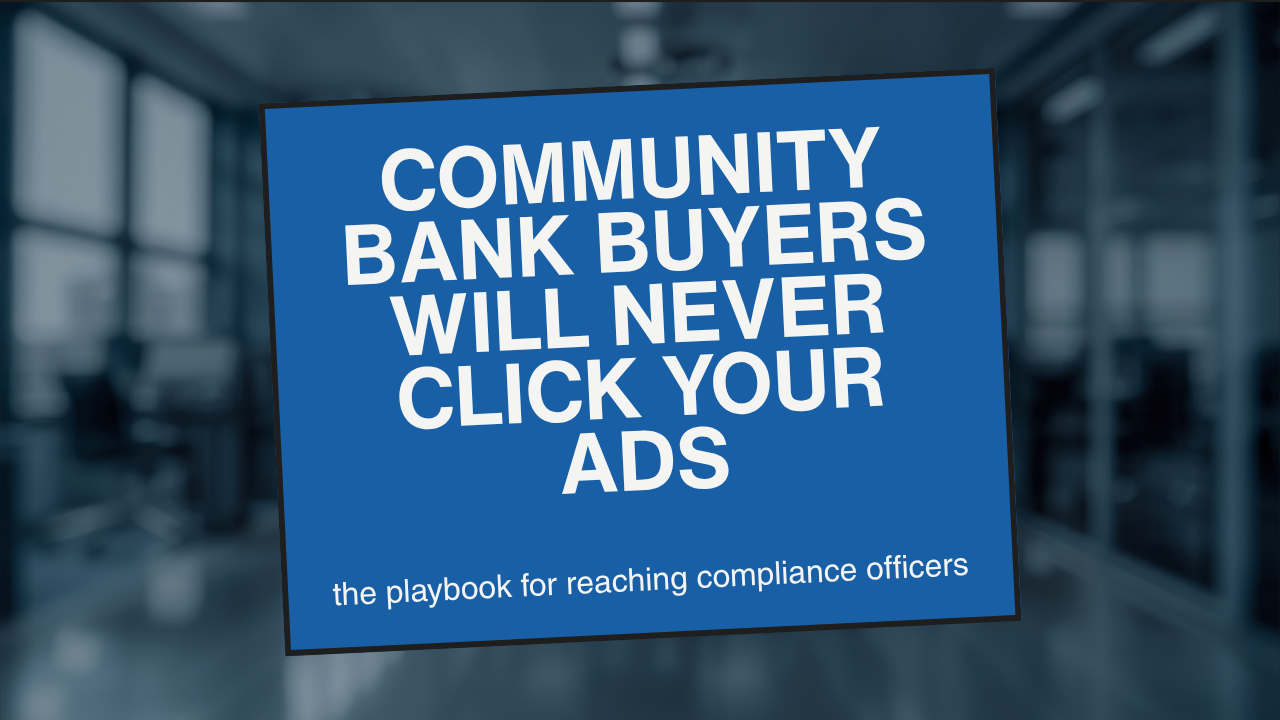
If you sell a product or service to community banks, you already know that the standard B2B marketing playbook doesn’t work here. Cold email open rates are low. LinkedIn ads reach the wrong people or go ignored by the right ones. And the buyers who control the budget — compliance officers, CFOs, risk managers — are not browsing the internet looking for your solution.
This playbook is for fintech companies, software vendors, consulting firms, and service providers that sell into the community banking sector. It is built around one central insight: community bank buyers make decisions based on trust, peer validation, and regulatory relevance — not brand awareness or marketing volume.
Community banks operate in a heavily regulated environment where the cost of a bad vendor decision is not just financial — it’s reputational and regulatory. A compliance failure that traces back to a third-party software implementation can trigger examiner findings, consent orders, and executive liability.
That risk calculus shapes everything about how community bank buyers evaluate and select vendors. They move slowly by design. They rely on peer recommendations from other bankers they know personally. They read the guidance documents from their core processors and their state banking associations before they read your marketing materials.
The Compliance Officer
The compliance officer is often the de facto gatekeeper for technology and service vendor selection at community banks. She is responsible for BSA/AML, CRA, fair lending, vendor management, and a growing list of regulatory requirements. Her evaluation criteria are straightforward: Will this create an examiner finding? Has this been implemented successfully at institutions like ours?
Content that earns her attention is content that demonstrates knowledge of her regulatory environment — not just the surface layer, but the specific exam procedures, guidance letters, and compliance frameworks she works with daily.
The CFO
The community bank CFO is focused on margin, efficiency, and the balance sheet. Net interest margin pressure is a persistent concern. So is the cost of compliance and the overhead of legacy core systems.
The CFO responds to financial specificity: cost savings with attribution, efficiency ratios from similar-sized institutions, and return-on-investment calculations that hold up to scrutiny. Vague claims about “reducing costs” or “increasing efficiency” register as marketing noise.
The Risk Manager
At community banks with dedicated risk management functions, the risk manager is increasingly involved in vendor selection — particularly for technology vendors that handle customer data or touch core banking systems.
Risk managers want documentation: SOC 2 reports, business continuity plans, incident response procedures. Marketing content that speaks their language includes operational risk frameworks, third-party risk management guidance, and evidence of institutional controls.
The CEO/President
The community bank CEO is typically the final decision-maker for significant vendor commitments. But they are rarely the initiator. Deals that reach the CEO’s desk have already been evaluated and recommended by the compliance officer, CFO, or risk manager.
The most effective marketing to the CEO is marketing that has already moved the internal evaluation team — because the CEO almost always defers to the judgment of the people who will live with the implementation.
Peer Community and Industry Events
The state banking association conference is the most important marketing channel for any company selling to community banks. These events concentrate your exact buyer audience in a room where peer conversations happen naturally and credibility can be established in person.
Sponsoring the right breakout sessions, hosting roundtable conversations on compliance or operational topics, and being visible in the community that community bankers trust — these activities build the kind of credibility that no digital campaign can replicate.
Regulatory and Compliance Content
Content that helps community bankers do their jobs — understand a new examination procedure, implement a regulatory change, navigate a guidance letter — earns the kind of trust that marketing content almost never does.
A practical guide to the current FFIEC examination manual for your product category is more valuable to a compliance officer than any amount of brand awareness advertising.
Case Studies from Similar Institutions
“A $400 million community bank in the southeast” is a more compelling case study anchor for your audience than “a leading financial institution.” Community bank buyers want to see results from institutions that match their asset size, charter type, and market geography.
The specificity of the case study signals the specificity of your understanding.
Referrals from Trusted Vendors
Community banks work closely with their core processors, external auditors, and legal counsel. A warm introduction from a trusted vendor in that ecosystem is worth more than any cold outreach campaign.
Building relationships with the companies that already have the trust of your target buyers — and creating genuine partnership value that earns referrals — is one of the most powerful distribution strategies available to companies selling into this sector.
Cold email to compliance officers and CFOs at community banks is largely wasted effort. These buyers receive high volumes of vendor solicitation and have strong filters. Generic outreach about “solutions” and “partnerships” reads as exactly what it is.
Broad digital advertising targeting “banking professionals” or even “community bank executives” produces mostly noise. The targeting parameters available on major platforms are not specific enough to reach your buyer without significant waste.
Content that demonstrates no understanding of the regulatory environment — or worse, gets regulatory details wrong — actively damages your credibility with buyers who spend their careers in compliance.
A pipeline cultivation strategy for the community banking sector is built around three assets: a conference presence, a content engine, and a referral network.
The conference presence establishes you in the community. The content engine — one or two genuinely useful pieces per month on regulatory or operational topics — keeps your company visible to buyers who are not yet ready to buy. The referral network generates the warm introductions that move relationships forward.
Deals in this sector rarely close in less than six months. A 12-month view is the minimum viable planning horizon.
Community bank buyers are sophisticated, risk-averse, and relationship-driven. The companies that win in this market are the ones that demonstrate deep sector knowledge, show up consistently in the places their buyers gather, and build trust through content and peer validation rather than marketing volume.
If you sell into the community banking sector and your pipeline isn’t reflecting the quality of your product, the problem is almost certainly the strategy — not the solution you’re selling.
AI is used to help research topics, create content and produce audio or video files for this site. This allows me to keep my primary focus on delivering results for clients.

 The Conference Pipeline: B2B Lead Generation at Industry Events